










International Law Recognition of Collective Values and the Role of Affective Categories
CILRAP Bottega (Florence) and Camaldoli, 26-28 October 2026
Related roundtable in the CILRAP Bottega 260123-24 | Policy Brief No. 200 based on the roundtable process | Chapter 1 of PS 36 | PS 36 (‘Philosophical Foundations of International Criminal Law: Legally-Protected Interests’) | PS 46 (‘Legal Construction of Common Humanity: Human Agency in a Cosmopolitan War Crimes Law’) | PS 47 (‘Norm Efficacy and Justification in International Criminal Law’) | Related online library on philosophical foundations of ICL | CILRAP Conversation with Prof. Buis | CILRAP Conversation with Prof. Aksenova | CILRAP Conversation with Dr. Sabet | 251201 'Frontiers of International Law and Justice' | Film about 251201 launch of PS 46

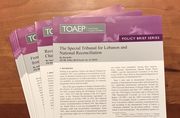
Drawing on TOAEP’s anthology Philosophical Foundations of International Criminal Law: Legally-Protected Interests (in particular sections 1.4.3. and 1.5.), the 260123-24 CILRAP roundtable, and TOAEP’s subsequent Policy Brief No. 200 (co-authored by Morten Bergsmo, Marina Aksenova, Emiliano J. Buis, Sergio Dellavalle, Richard J. Goldstone, David Luban, Natalia Luterstein, Rod Rastan, Shahrzad Sabet, Narinder Singh and Song Tianying), this three-day roundtable focussed on affective or emotional categories that motivate and sustain the recognition of collective values or interests by international law, including the value of ‘unity of humankind’.

The invited roundtable participants included Associated Professor Marina Aksenova (IE University, Madrid), Dr. Ioanna Anastasopoulou (Managing Partner, A Law Firm, Athens; and Assistant Professor, Faculty of Law, University of Athens), Professor Emiliano J. Buis (University of Buenos Aires), Professor Sergio Dellavalle (University of Turin), Adjunct Professor Gunnar M. Ekeløve-Slydal (University of Southeast Norway; Director, CICJ), Professor Natalia Luterstein (University of Buenos Aires), Dr. Rod Rastan (Chief of the Judicial Cooperation Support Section, International Criminal Court) and Dr. Shahrzad Sabet (Co-Director, COMIT; Fellow, New York University’s Institute for Public Knowledge), in addition to CILRAP Director Morten Bergsmo and Dr. Song Tianying (CILRAP Research Fellow; Member, CICJ Steering Group), assisted by CILRAP Fellows Antonio Angotti and Rohit Gupta. The group convened in the CILRAP Bottega in Florence and in Camaldoli Monastery in the mountains east of Florence.

In his opening remarks, Bergsmo situated the inquiry within the framework of international law-making and development, underlining that affective categories are relevant not only to norm-creation but also norm-acceptance and -maintenance. He addressed the significance of understanding the motivational capacity of relevant affective categories in this context. He suggested that the group should also consider the dynamics of international criminal law public policy, and how constructive initiatives should be encouraged and nourished from all corners of the world (not limited to foreign ministry lawyers). Buis then presented a comprehensive theoretical framework for the discussion on affective categories in international law, providing an overview of relevant literature, distinctions, and how the group’s work may contribute to the discourse.
There was an emphasis on affective categories that underpin the collective value of ‘unity of humankind’. Among the affective categories discussed more in-depth were empathy, compassion, caritas, sense of global solidarity, sense of world citizenship, and belief in the ‘oneness of mankind’. The group also discussed affective categories and the body of writings of some international lawyers who were particularly concerned with community interests.
Papers developed as part of the roundtable will be included in the second, expanded edition of Philosophical Foundations of International Criminal Law: Legally-Protected Interests. The roundtable forms part of CILRAP’s ongoing research project on philosophical foundations of international criminal law.